

Art & Sports has quietly moved from a decorative sub-category to one of the more closely watched growth stories in contemporary collecting. This study examines why: the auction-house data, the institutional validation, the new collectors entering through sport and culture rather than the traditional gallery system, and the hospitality and wellness economy now treating movement-related art as a design imperative rather than an afterthought.
I. The Scale of the Shift
The wider art market gives this theme its first piece of context. Global art sales reached an estimated $59.6 billion in 2025, returning to growth after two difficult years, and high-net-worth collectors now allocate an average of 20% of their wealth to art — up from 15% in 2024. That expansion has not been evenly distributed: photography's dealer-market share doubled from 3% to 6%, prints and multiples rose to 12%, and buyers increasingly favour work that is conceptually legible and photographically or documentarily grounded — exactly the register much contemporary sport-related art occupies.
Sport-related art is riding this wider recovery rather than sitting outside it, but it is doing so from an unusually advantaged position: it has a foot in two expanding markets simultaneously — the traditional fine-art market described above, and the fast-growing collectibles and sports-memorabilia market, which auction houses now treat as a core, not peripheral, business line.
II. From Memorabilia to Masterwork: The Auction House Signal
The clearest evidence that sport is being taken seriously as a collecting category comes from the auction houses themselves. Sotheby's entered the sports-memorabilia market in May 2020 with the sale of an early pair of Air Jordans, and has since built it into what the house itself describes as "one of the bigger luxury categories" it sells — culminating in a 2024 "Holy Grails" trading-card sale that brought in more than $7 million from bidders in twenty countries.
What matters is that this memorabilia boom is running in parallel with a genuine fine-art market for sport-related subject matter, and the two increasingly reinforce one another. Anna Park's charcoal tennis drawings — closely cropped, physically tense studies of competitive effort — now carry an auction record of $484,307 (Christie's Hong Kong, 2022), following her move to Lehmann Maupin in 2025. Alvin Armstrong, whose paintings render Black athletes and figures in motion, set an auction record of $15,120 at Christie's New York in 2023. Richard MacDonald's bronze athletes have traded as high as $61,750 at auction. Perhaps most tellingly, Caroline Coon — whose In the Arena paintings have treated football and competitive sport as a subject since 1990 — only joined blue-chip gallery representation in 2022, prompting Frieze to publish a feature bluntly titled "The Art World Finally Wakes Up to Caroline Coon."
That last example is the pattern worth watching most closely: veteran, serious artists whose sport-related work was previously overlooked precisely because it was about sport are now being re-priced and re-historicised by the market — a strong signal that the subject itself is being taken more seriously, not just the artists working in spite of it.
III. Institutional Validation: Biennials, Festivals and the Olympic Platform
A market rally driven only by auction houses would be a pricing story. What makes Art & Sports a genuine curatorial territory is that major public institutions have started building permanent and semi-permanent infrastructure around it.
- Manchester International Festival 2025 staged Football City, Art United, co-curated by Hans Ulrich Obrist with footballer Juan Mata, pairing major contemporary artists — Paul Pfeiffer, Rose Wylie, Suzanne Lacy — with current and former professional players.
- Liverpool Biennial 2025 commissioned Cevdet Erek's Away Terrace (Us and Them), a large-scale installation recreating football-stadium terrace architecture and acoustics.
- OOF Gallery, a contemporary art gallery devoted entirely to football, now operates permanently inside Tottenham Hotspur Stadium in London.
- The Paris 2024 Cultural Olympiad commissioned seven artists to create official Olympic and Paralympic poster diptychs, with LVMH's luxury houses formally attached to the programme.
- LA28's Cultural Olympiad, unveiled in 2026, is being built citywide around local artists and community institutions.
Taken together, these are not marketing exercises attached to sporting events — they are museums, biennials and festivals choosing sport as curatorial subject matter on its own terms. That is the strongest available evidence that the category has crossed from novelty into legitimate art-historical territory.
IV. The New Collector: Athletes, Gen Z and Experiential Wealth
Athletes as collectors — and tastemakers
A growing number of professional athletes collect seriously rather than decoratively. Grant Hill has built a museum-quality collection of African American art. Amar'e Stoudemire collects Basquiat, Rob Pruitt and Hebru Brantley, and curated a basketball-themed exhibition with Sotheby's during 2018 NBA All-Star Weekend. David Beckham has assembled a contemporary British art collection built around a long relationship with White Cube. These are not passive endorsements — several actively curate, lend institutional credibility, and pull their own following toward contemporary art in the process.
A demographic handover
Millennial and Gen Z buyers now make up roughly three-quarters of the active collector base, and their habits differ meaningfully from prior generations. For a category like Art & Sports, which sits naturally at the intersection of fine art, fashion, sneaker culture and fandom, this is a structurally favourable buyer profile rather than a coincidental one.
Brand culture is validating the crossover
Nike's collaboration with Anne Imhof — the German artist who won the Golden Lion at the 2017 Venice Biennale — to reinterpret its Total 90 football jersey line is a useful marker: a Venice Biennale-calibre conceptual artist working directly inside a mass sportswear brand, treated by both sides as a serious creative partnership rather than a licensing exercise.
V. Wellness, Hospitality and the Architecture of Movement
The strongest structural tailwind for this theme may not be the art market at all, but the hospitality and wellness economy that increasingly commissions work like it. The Global Wellness Institute forecasts the wellness economy will reach $8.5 trillion by 2027, and hotel groups are responding by building sport and movement into both programming and permanent art collections. Kerzner International's SIRO concept is built entirely around athletic performance and recovery; Accor's MGallery Creekside property in Dubai commissioned 482 artworks from 52 artists specifically to support a luxury-sport-and-wellness positioning.
This matters commercially because it creates a buyer for sport-related art who is not a traditional private collector at all: hospitality groups, wellness developers and architecture-led residential projects, actively seeking work that communicates movement subtly and integrates naturally into architecture rather than literal sporting imagery.
VI. Risks and Curatorial Discipline
Three caveats are worth stating plainly, in keeping with ArtsBouquet's position as a serious rather than purely promotional platform:
- Memorabilia is not the same market as fine art. Sotheby's trading-card and sneaker sales are real and growing, but they are a distinct asset class from artist-driven work, with different collector psychology and liquidity. Conflating the two overstates how deep the fine-art buyer pool for sport subject matter actually is.
- Pricing remains genuinely opaque outside the auction-recorded names. The majority of artists working in this territory do not publish prices and sell primarily through galleries on request.
- The category still carries a decorative-cliché risk. The same market forces pulling serious institutions toward sport are also flooding the lower end of the market with generic, licensed sport imagery. ArtsBouquet's curatorial value lies specifically in distinguishing the two.
The collection
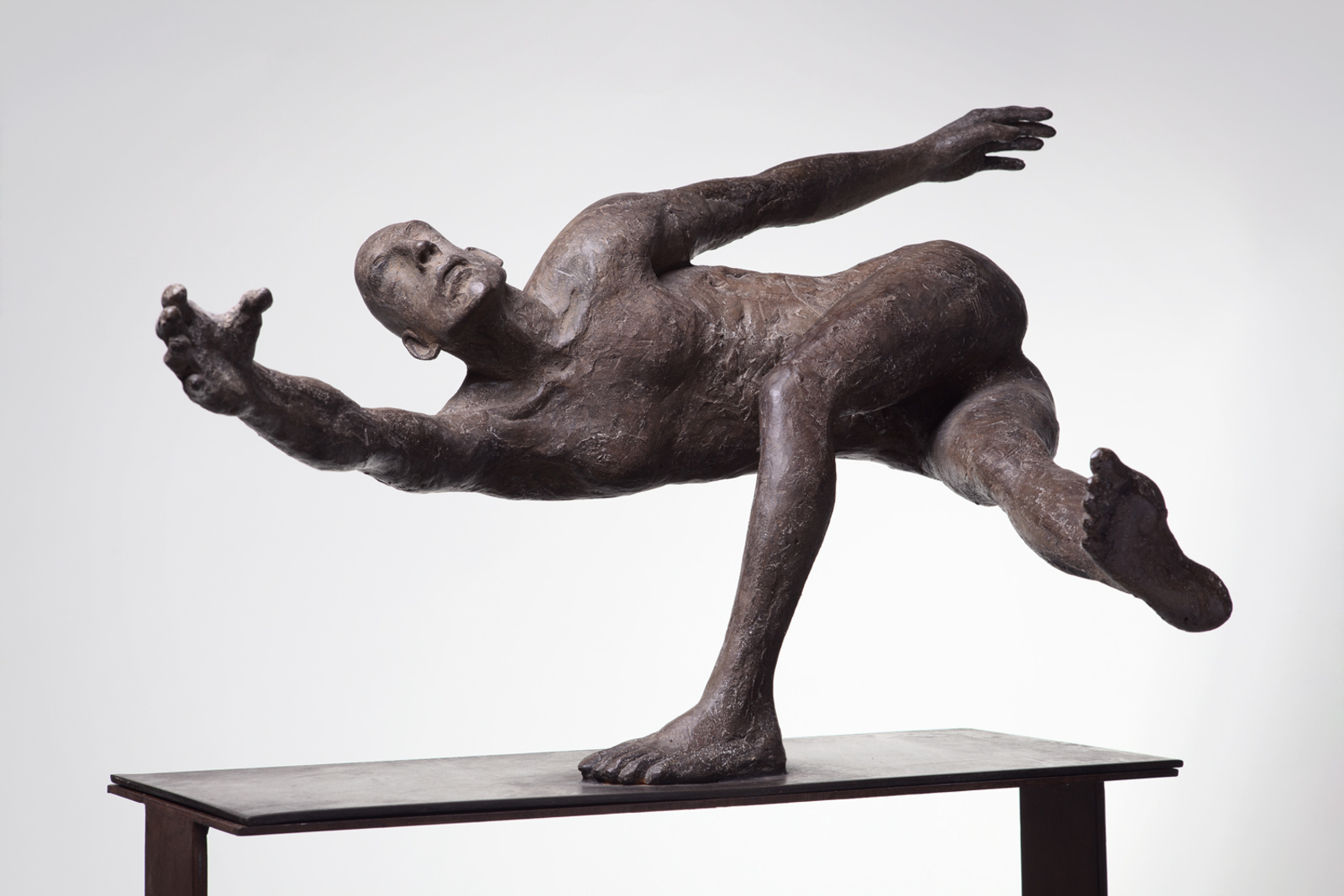
The last of those three caveats is the reason our Art & Sports collection is twenty-four works rather than two hundred. Every piece in it had to survive the same test: does it hold up as art once you take the sport out of the sentence?
Section V above describes a buyer looking for work that communicates movement subtly and integrates into architecture. That buyer is the reason the collection weights toward gestural and sculptural work rather than licensed portraiture — Marta Moreu's bronzes, represented in Barcelona and Paris; Nicholas Stedman's panels of figures in flight; Ilya Volykhine's winter scenes; Olesia Zyppelt's athletes at the moment before release.
It is priced to be entered rather than admired: $1,750 to $25,200, with shipping included worldwide and insured to full value, and fourteen days to return. For designers and architects specifying against a project, works by artists we represent directly carry a trade discount.
See the Art & Sports collection → · ArtsBouquet for Designers →